

You’re standing in the toy aisle. Everything is beeping. Half the boxes promise to teach your baby Mandarin, coding, and emotional regulation before nap time. And your one-year-old? She’d honestly rather play with the box.
Here’s the thing: she’s onto something. The toys that actually hold a one-year-old’s attention are almost never the loudest ones. They’re the simple ones — the toys that let her do the work instead of doing it for her. That’s the whole heart of the Montessori approach, and it’s why Montessori toys for 1 year old play have such a devoted following among parents and toddler teachers alike.
I’ve rounded up ten that earn their spot on the shelf. Most are under $25. One is completely free.
Table of Contents
What Makes a Toy “Montessori,” Anyway?
Quick crash course, because the label gets slapped on everything these days. A true Montessori-style toy usually checks three boxes: it’s made of natural materials (wood, fabric, metal — things with real texture and weight), it isolates one skill at a time, and it’s powered by your child, not batteries. No lights, no songs, no “good job!” voice. The reward is built into the toy itself — the ball drops, the ring stacks, the lid opens.
That last part matters more than it sounds. When a toy does the entertaining, your baby watches. When the toy waits for her, she works. And one-year-olds love to work.
How I Picked These Montessori Toys for 1 Year Old Play
Every toy below targets a real 12-to-24-month milestone — the pincer grasp, posting objects into holes, pulling to stand, early problem-solving. I also weighted heavily toward toys that survive actual toddlers and actual budgets. You won’t find anything here that requires a payment plan. Pinky promise.
1. Object Permanence Box
If you buy one thing from this list, make it this one. It’s a simple wooden box with a hole on top and a tray in front: ball goes in, ball disappears, ball rolls back out. Magic, as far as your baby is concerned. It teaches object permanence — the idea that things still exist when you can’t see them — which is the same concept that makes peek-a-boo so hilarious at this age. Lovevery’s version gets all the Instagram love, but the $20 wooden ones on Amazon do the exact same job.
2. Wooden Stacking Rings
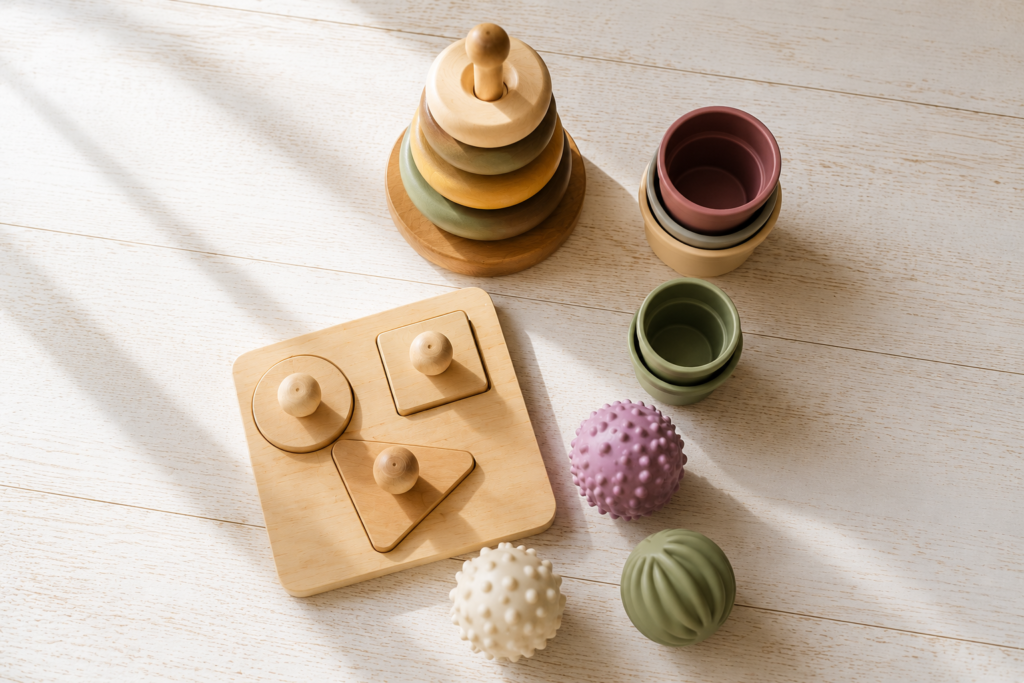
A classic for a reason. Stacking rings build hand-eye coordination, size discrimination, and that satisfying thunk of success. Look for a version with a straight wooden dowel and chunky rings. At 12 months it’s all about pulling rings off; somewhere around 15 to 18 months, the stacking clicks — and watching that click happen is genuinely one of the best parts of this age.
3. Nesting and Stacking Cups
The budget hero. A set of nesting cups costs less than a fancy coffee and covers an absurd amount of developmental ground: stacking, nesting, hiding things, knocking towers down, scooping water at bath time. True story: a $6 set of cups outlasted every single light-up toy my kid got that year. Some toys are one-trick ponies. Cups are the whole circus.
4. Simple Wooden Shape Sorter
Skip the 12-shape monsters — at this age, simpler is smarter. A Montessori-friendly sorter starts with just one to three shapes, so your toddler gets to feel successful instead of frustrated. Posting a circle through a hole is serious cognitive work for a one-year-old: it takes grasping, rotating, aiming, and releasing, all in one move.
5. Wooden Push Walker or Wagon
For brand-new and almost-walkers, a weighted wooden push wagon is gold. It supports those wobbly first steps without doing the balancing for them (which is why many pediatric physical therapists prefer push toys over seated walkers). Bonus: it becomes a stuffed-animal taxi for years afterward.
6. Chunky Knob Puzzles
First puzzles with big wooden knobs are sneaky fine-motor workouts. Grasping the knob uses the same three-finger grip your child will eventually use to hold a pencil. Start with a three-piece puzzle with simple shapes or animals, and expect it to be dumped out far more often than it’s completed. That’s still learning, I promise.
7. Ball Drop and Tracker Toys
A ball tracker — where a wooden ball zigzags down ramps — is the perfect “watch, then do” toy. Your toddler drops the ball, tracks it with her eyes (great for visual development), then squats down to retrieve it about four hundred times in a row. You make the coffee. Everybody wins.
8. Textured Sensory Balls
A set of textured balls in different sizes gives little hands a full sensory menu: bumpy, ribbed, squishy, smooth. They’re perfect for rolling back and forth — one of the earliest turn-taking games — and they pair beautifully with the sensory bins you may already have going. If your little one is in a “throw everything” phase, these are also the safest possible answer.
9. A Pikler-Style Climbing Triangle
The splurge of the list, so let me make the case. One-year-olds are climbers. They will climb something — the question is whether it’s a foldable triangle built for it or your bookshelf. A Pikler-style triangle lets them practice climbing at their own pace, which builds strength, balance, and (this is the Montessori part) real judgment about their own bodies. Many fold flat for storage, and the cost-per-use over the toddler years works out to pennies.
10. A DIY Treasure Basket
The free one! Grab a low basket and fill it with safe, real household objects: a wooden spoon, a metal whisk, a silicone muffin cup, a fabric scrap, a large smooth shell. One-year-olds find real things endlessly more interesting than toy versions of things — anyone whose child has ignored a toy phone to lunge for the real one already knows this. Swap the objects every week or two and it’s a brand-new basket.
A Quick Word on Safety
Whatever you choose, run it through the choke test: anything that fits through a toilet paper tube is too small for this age. Check wooden toys for chipping paint and loose parts now and then, and supervise climbing toys. The American Academy of Pediatrics has a helpful guide to choosing safe, age-appropriate toys if you want a deeper read — it’s reassuringly common-sense.
You Don’t Need All Ten
Real talk before you go fill a cart: the Montessori philosophy actually favors fewer toys, rotated often. A one-year-old with four good options will play longer and deeper than one buried in forty. So pick two or three from this list, set them on a low shelf where she can reach them herself, and watch what she gravitates toward.
The best Montessori toys for 1 year old development aren’t the prettiest ones on the shelf — they’re the ones your child returns to again and again, working that little brow furrow of concentration. You know the one. That face is worth more than any toy aisle promise. If you’re looking for more ideas, be sure to check out Montessori Activities for 1-Year-Olds
You’ve got this, mama. 💜